
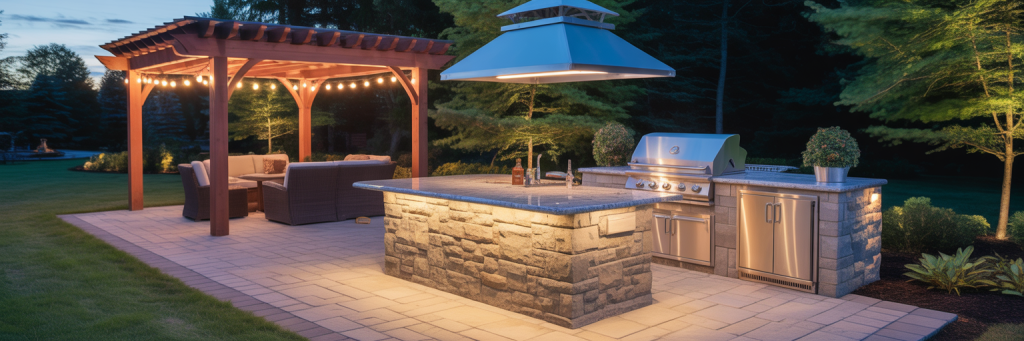
Why outdoor kitchen cost Connecticut moves so much
If you are comparing bids right now, outdoor kitchen cost Connecticut is the line you need to watch. Local labor rates, frost‑line excavation, permit requirements and the type of countertop or stone veneer you pick all change a quote by thousands of dollars. If you want a fast local reference, start with the site estimate at a Walkway & Patio Connecticut project page and then use the checklist below to spot padding or missing line items in any estimate.
Top cost drivers: counters, stone veneer, utilities, grill, patio base, seating and lighting
When contractors price an outdoor kitchen they group costs into hard components and soft components. Hard components are materials you can point to: countertop, veneer, built‑in grill or refrigeration. Soft components are permits, trenching for gas, running a dedicated 120/240V circuit, and labor for excavation and frost‑proof base. A typical contractor estimate lists them separately; if it does not, ask for an itemized breakdown.
- Counters and finishes: Concrete, bluestone or granite will raise the budget. Prefab stainless or compact surface tops are cheaper to install but change the finished look and long‑term maintenance.
- Stone veneer and facing: Natural stone veneer costs more than manufactured thin stone but often lasts longer. Veneer choices can swing your price 15 to 40 percent for a mid‑size island.
- Utilities — gas, water and electric: Every dedicated circuit, GFCI outlet, shutoff valve and gas run adds hours and permits. Running a gas stub is commonly several hundred dollars; long runs, trenching or permit fees push that into thousands.
- Grill and appliances: Built‑in grills vary widely. A basic built‑in gas grill can cost $1,000; premium commercial models can exceed $10,000. Add a refrigerator, sink, pizza oven or smoker and the price rises quickly.
- Patio base and paving: Proper base preparation for pavers, bluestone or poured concrete is the foundation of a durable installation. For Connecticut you must account for freeze‑thaw and frost depth when sizing base and edge restraint.
- Seating, shade and lighting: Built‑in seating or an island bar increases masonry work. Lighting and low‑voltage wiring are modest individually but add up for zones and smart control.
Component‑by‑component breakdown
Counters and surfacing
Concrete counters built on site and properly sealed are common in Connecticut and give a custom look. Prefabricated granite or quartz can be less labor intensive but require precise framing. Expect materials and installation to range from about $60 per linear foot for simple stainless tops to $200 or more per linear foot for premium stone and custom edge work.
Stone veneer and facing
Thin natural stone veneer or manufactured stone veneer changes the look and the cost. Labor for veneer is a large part of the price because cutting and setting face stones is skilled masonry. Budget 25 to 60 percent of your masonry line item for labor in Connecticut towns where masons command higher hourly rates.
Utilities: gas, water, electric
Some users repeatedly warned that utility stub costs are often underquoted. Running a new gas line from the house to the island can be a few hundred dollars for a short run but can exceed $2,500 when trenching, permits and inspections are required. A dedicated outdoor electrical circuit for a refrigerator, lighting and heater commonly adds $800 to $3,000 depending on panel work. A basic plumbing rough‑in for a sink typically starts near $800 and rises with distance and code work.
Built‑in grill and appliances
Grill cost is a big lever. A good entry‑level built‑in grill is roughly $1,200 to $2,500. A professional series grill from a premium brand is commonly $6,000 to $12,000. If you are comparing quotes, confirm whether the contractor included the grill, enclosure, hood clearances and the noncombustible backing that many manufacturers require for warranty compliance.
Patio base and paver cost
Proper base depth is nonnegotiable in CT because of frost movement. Reliable experts advised 8 to 12 inches of compacted aggregate base with mechanical compaction in 2‑inch lifts for flagstone or pavers under an outdoor kitchen. The site’s existing guide to pavers lists small patio costs (10×10) at $2,500 to $7,000 and medium patios (20×20) with features at $8,000 to $25,000. Use those local paver benchmarks when estimating the patio base cost for your island.
Seating, roof, shade and lighting
Built‑in seating or a stone bar is essentially extra masonry cost. A pergola or covered roof will add structural footings, framing and potentially roofing tie‑in work. Accent lighting and low‑voltage wiring commonly run $1,000 to $6,000 depending on zones and controls.
How to compare bids and spot common traps
Ask for an itemized bid that separates labor, materials, stone veneer, electrical, plumbing and permits. Watch for these red flags:
- One‑line lump sums with no breakdown of base prep, drainage or edge restraint.
- No written allowance for gas and electrical permits and inspections.
- Missing edge restraint or reduced base depth compared with the advertised scope.
- Vague warranty language. Ask for explicit workmanship warranty and product warranty transfers.
When a contractor quotes significantly less than others, get specifics on base depth, compaction method and whether the quote includes a licensed plumber and electrician.
Quick comparison: DIY, hybrid and full contractor builds
| Approach | Pros | Cons |
|---|---|---|
| DIY | Lowest cost; control over materials; good for small projects | Requires time, skill, permits and tool rental; risk of poor drainage or frost damage |
| Hybrid (owner does patio, pro does utilities and build) | Balance of cost savings and specialist work for critical systems | Requires coordination; owner still responsible for correct base and compaction |
| Full contractor | Single point of responsibility, permits and inspections handled | Highest cost; must vet contractor carefully to avoid long delays or cost creep |
Local checklist for Connecticut homeowners
Before you sign any contract, do these five things. These are drawn from local project threads and Alpha Hardscapes best practices:
- Confirm frost depth and required footings with the contractor and get base depth written into the contract.
- Ask for separate line items for gas, electrical, plumbing and permits so you can compare apples to apples.
- Get the grill and appliances specified by make/model in the bid so required clearances and backing are priced.
- Request recent local references and photographs of comparable CT projects.
- Reserve a contingency of 10 to 20 percent for unknown site issues or scope changes.
If you want help refining scope for your yard, see related resources on Walkway & Patio Pavers and contact us for a site estimate on the form at Contact Alpha Hardscapes.
Common contractor questions from real owners (use these when you vet)
- How deep will the aggregate base be and how will it be compacted?
- Who pulls permits for gas and electrical, and who schedules inspections?
- Are appliance curb supports and noncombustible backing included for the built‑in grill?
- What is the written workmanship warranty and what does it exclude?
Frequently Asked Questions
How much does an outdoor kitchen cost in Connecticut?
The range is wide because scope varies. A small built‑in island on a concrete pad can be done under $10,000 if you buy a moderate grill and limit utilities. A fully custom stone veneer island with premium appliances, refrigeration, pizza oven, pergola and engineered patio base commonly falls between $35,000 and $120,000 in Connecticut towns. Use comparable local bids to narrow your estimate.
Is a $40,000 to $50,000 quote reasonable?
Yes. That range is reasonable for a mid to high mid‑range build that includes stone veneer, a premium built‑in grill, sink, fridge, lighting and a properly engineered patio. If you receive such a quote, confirm the base prep, utility line items and warranty terms. Some homeowners achieved similar scope for less when they provided materials or split work phases.
Do I need permits for an outdoor kitchen in Connecticut?
Permits depend on town codes and the work you do. Utility work, trenching for gas, new electrical circuits and plumbing commonly require permits and inspections. Confirm with your contractor which permits are included in the quote and check with your local building department for specifics. Unpermitted work may affect resale and insurance.
What does a built in grill patio cost?
Built‑in grill patio cost depends on the grill, enclosure materials and the patio finish. A basic built‑in grill with a simple masonry surround on a small paver pad can start near $6,000. Upgrading to natural stone veneer, a larger island, dedicated appliances and a reinforced base will commonly push cost into the $15,000 to $50,000 range.
Should I DIY parts of the project to save money?
Many Connecticut homeowners DIY the patio surfacing or landscaping to save money while hiring licensed pros for gas, plumbing and electrical. Homeowners get successful DIY savings when they are comfortable with compaction, grading and permit coordination. If you DIY, document work and keep a clear handoff to pros for utilities to avoid scope gaps.
Conclusion
The primary variable in outdoor kitchen cost Connecticut is scope. Counters, stone veneer, utilities, the built‑in grill and a frost‑proof patio base together determine whether you land in the low tens of thousands or well into six figures. Use the checklists and questions above when you compare bids, and prioritize a correctly compacted base and licensed utility work. If you want a tailored estimate for your property, start with a site visit and an itemized plan so your budget reflects real site conditions and not guesswork.