
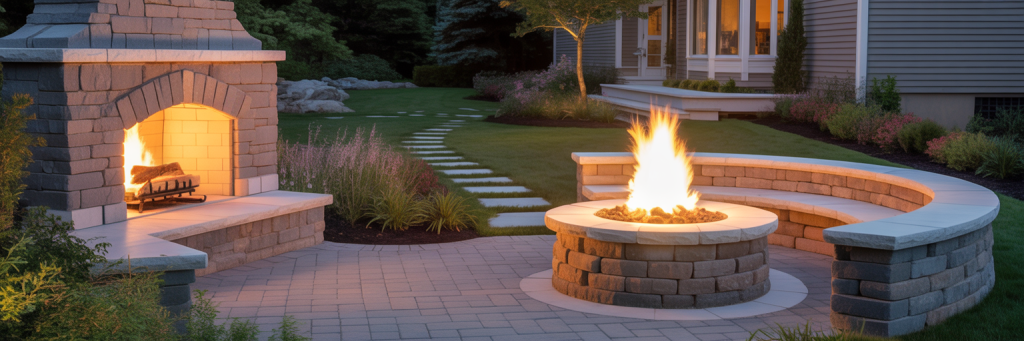
Fire Pit vs Outdoor Fireplace: Which Hardscape Feature Fits Your Yard?
Choosing between a fire pit vs outdoor fireplace is one of the first decisions property owners make when planning an outdoor living upgrade. If you are in Connecticut and want a feature that pairs with patios or outdoor kitchens, start with this service page: Outdoor Fire Features in Connecticut to see how designs are built for local freeze-thaw conditions. This guide compares costs, code and permit realities, site fit, maintenance, safety, and design value so you can pick the right hardscape feature for your yard. If you want to talk to a local pro, call (475) 227-6896 to reach Alpha Hardscapes LLC.
Why the choice matters for Connecticut yards
Connecticut winters and compact suburban lots shape how a fire feature performs and how long it lasts. Alpha Hardscapes highlights three persistent local requirements found in their work: quality masonry to resist freeze-thaw cycles, correct placement relative to structures, and integration with patios or retaining walls to maintain drainage and sightlines. Those are not just design preferences. They are practical answers to common problems homeowners experience when features are built without a contractor familiar with local conditions.
Side-by-side: Fire pit vs outdoor fireplace (at a glance)
The following table summarizes the key differences to help you narrow the choice based on budget, function, and yard size.
| Feature | Fire Pit | Outdoor Fireplace |
|---|---|---|
| Typical cost range (installed) | $400 to $4,000 (portable to masonry bowl). | $4,000 to $20,000 (masonry, built-in). |
| Space required | Small to medium yards, flexible placement | Medium to large yards; requires a stable hearth and clearance |
| Warmth and wind protection | Lower radiant heat; exposed to wind | Higher radiant heat; better wind blocking and viewing height |
| Design and resale value | Casual, social; good ROI for informal spaces | Architectural focal point; strong curb and property value appeal |
| Permit and code | Often allowed with setback rules; check local burn ordinances | May require masonry code compliance, chimney flue sizing, and permits—check local building department and NFPA guidance |
How to decide: 6 practical questions to ask before you build
Answer these fast to see which feature fits your yard and lifestyle.
- What is the main purpose? If you want casual s’mores nights and flexible seating, a fire pit is ideal. If you want a year-round focal point that resembles indoor fireplaces, an outdoor fireplace makes sense.
- How much space do you have? Fire pits can fit compact patios; fireplaces need a dedicated hearth and clearance for the chimney.
- Do you want wood smoke or cleaner flame? Gas fire pits and fireplaces reduce smoke and cleanup but add plumbing or gas-line costs.
- What is your budget? Expect a masonry fireplace to cost several times a quality masonry fire pit when labor, foundation, and flue work are factored in.
- Local code and permits: Town rules in Connecticut vary. The Connecticut Department of Energy and Environmental Protection (DEEP) has regulations on open burning that influence wood-burning features; always confirm with your town building department.
- Do you want integrated hardscaping? If you plan to rebuild a patio, seating wall, or outdoor kitchen, coordinate the fire feature with those elements for better long-term performance. See related patio cost planning at Patio Installation Cost Connecticut.
Cost detail and real numbers
Budgeting is the single most common stumbling block. National cost aggregates give useful ranges:
- HomeAdvisor shows simple built-in fire pits starting near $400 for a basic kit and rising to $3,000–$4,000 for high-end masonry bowls with seating.
- Masonry outdoor fireplaces, depending on stone type, chimney work, and foundations, commonly start around $4,000 and can exceed $15,000 for custom stonework and integrated hearths.
For a reliable local estimate that accounts for Connecticut site conditions, contact an experienced fire feature contractor. Alpha Hardscapes provides quotes that factor in snow load, frost depth, and drainage—three variables that meaningfully change labor and material costs.
Permits, codes and safety—what Connecticut homeowners must check
Two practical rules govern most installations:
- Check town building and fire departments for setback and flue requirements. Many towns in Connecticut require at least specific clearances from structures and property lines for wood-burning features.
- Follow national standards for chimneys and fireplaces. The National Fire Protection Association publishes standards that masonry installers and contractors use for safe construction. See NFPA for guidance on fireplaces and chimneys.
For health considerations, the United States Environmental Protection Agency warns about wood smoke and recommends proper fuels and good ventilation to limit particulate exposure. If smoke or neighbor complaints are a concern, a gas option often solves both problems.
Design and placement rules that save money later
Experienced contractors place fire features to protect foundations, maintain patio drainage, and preserve sightlines. Practical placement details to insist on with any contractor:
- Concrete footing or compacted crushed stone base under masonry fireplaces to avoid frost heave.
- Combustible clearances documented in writing. Ask for the setback measurements the installer will meet.
- Integrated seating or low walls that double as wind buffers to improve usable warmth without increasing fuel consumption.
Gas or wood: operational and maintenance tradeoffs
Wood delivers the traditional experience but needs storage, ash removal, and occasional repointing for masonry that sees heavy use. Gas fire pits and fireplaces cost more to install because of a gas line or propane tank, but they start with a switch and require minimal cleanup. For many Connecticut homeowners concerned about smoke in tight neighborhoods, gas is a practical compromise.
How contractors price installations
Local contractors price by three major factors: material, site preparation, and labor. Material includes stone, refractory liners, firebrick, and a stainless combustion bowl or burner. Site preparation covers excavation, base work, and drainage. Labor is the variable that moves estimates widely because good masonry and foundation work are time intensive. For related hardscape items that often accompany fire features, see Alpha Hardscapes’ pages on Outdoor Kitchen Cost Connecticut and Hardscaping Pavers Planning.
Common pitfalls homeowners regret
- Choosing portable or lightweight options that shift and crack in freeze-thaw cycles without a proper base.
- Ignoring local setback rules and then paying for rework or code-mandated removal.
- Underestimating the role of wind and failing to design a fireplace to block prevailing winds, which reduces comfort.
Real-world examples and outcomes
Alpha Hardscapes frequently documents projects in southern Connecticut where customers received stronger ROI by choosing a masonry fireplace integrated with a new patio. In one type of project, moving from a standalone portable pit to a built-in fireplace created a usable evening space through late fall and increased the perceived value of the outdoor room. If your project includes a patio remodel, see the cost guide at Patio Installation Cost Connecticut for budget alignment.
Quick decision flow: which to choose
- If you have under 200 square feet and want casual fire nights: choose a fire pit.
- If you want a strong architectural anchor, year-round visual presence, and higher heat output: choose an outdoor fireplace.
- If smoke and neighbor complaints are likely: choose gas. If atmosphere and crackling wood matter most: choose wood-burning but confirm town open-burn rules.
Frequently Asked Questions
Do I need a permit for an outdoor fireplace or fire pit in Connecticut?
Permits vary by town. Many Connecticut municipalities require permits for fixed masonry fireplaces and sometimes for large built-in fire pits. Portable, contained units are often exempt but still must meet setback and safety rules. Contact your local building and fire department and consult DEEP guidance on open burning for town-specific limits. For permit-aware installations, work with a local fire pit contractor Connecticut residents trust to obtain required approvals.
Which is better for a small yard: a fire pit or outdoor fireplace?
For small yards, a fire pit is usually better because it requires less dedicated foundation and can be placed closer to seating. An outdoor fireplace requires more clearance and a stable base but provides greater vertical presence and heat. If you are remodeling a small patio, coordinate the pit or fireplace with the patio plan to avoid costly rework later.
How much should I budget for a masonry outdoor fireplace in Connecticut?
Expect to budget at least $4,000 for a modest masonry fireplace; custom stonework, reinforced foundations, and chimney details commonly push costs higher. Accurate estimates depend on site conditions and whether you add integrated seating or lighting. Get a localized quote from a masonry contractor to capture frost-depth and drainage work in the price.
Can I burn wood safely in a fire pit near my house?
Yes, if you observe clearance rules, use seasoned hardwood, keep a spark screen or burner cover, and maintain a safe distance from eaves and combustible materials. Long-term safety also depends on proper venting and avoiding smoke accumulation in neighboring properties. If smoke is a concern, ask about a gas-burning option.
What maintenance does a masonry fireplace need in CT winters?
Annual inspection and cleaning, mortar joint repair as needed, and checking for freeze-thaw cracks are typical. Alpha Hardscapes builds with weather-resistant materials to reduce maintenance frequency, but a winter inspection is still a smart practice to catch small issues before spring thaw.
Conclusion
Choosing between a fire pit vs outdoor fireplace comes down to yard size, budget, desired ambience, and local rules. A fire pit fits small, casual spaces and lower budgets. An outdoor fireplace costs more but creates a long-lasting architectural focal point that extends outdoor use into colder months. For accurate budgeting and code-compliant installation in Connecticut, work with a local fire pit contractor Connecticut homeowners hire to account for frost depth, drainage, and permits. Start with a site assessment and written estimate from Alpha Hardscapes by calling (475) 227-6896 or visiting our fire features page to see completed work and ask for a free estimate.
References
- National Fire Protection Association (NFPA) – standards for fireplaces and chimneys.
- U.S. Environmental Protection Agency, BurnWise – guidance on wood smoke and air quality.
- HomeAdvisor – national cost ranges for fire pits and fireplaces.
- Connecticut DEEP – state environmental and burning guidance (check local town rules).
Internal resources: Patio Installation Cost Connecticut, Outdoor Kitchen Cost Connecticut, Hardscaping Pavers Planning.